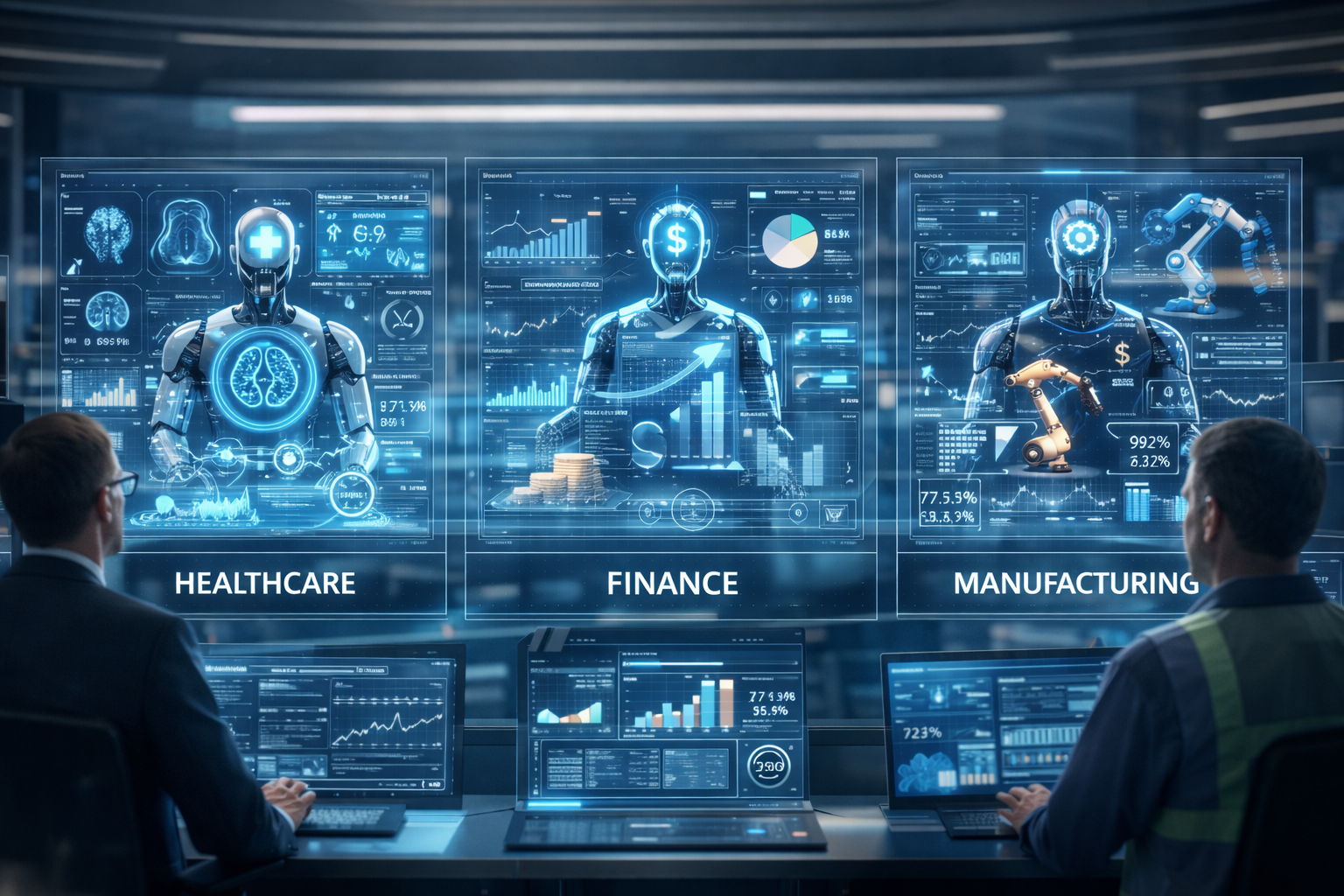
Artificial Intelligence AI is everywhere right now. It’s in our phones our favorite apps and even in school tools that help with homework or studying. But here is something a lot of people don’t talk about enough not all AI is built the same. That’s where industry specific AI models come in.
Instead of using one general AI model to do everything companies are now creating AI that’s trained for specific industries like healthcare, finance, retail or education. And honestly? That just makes way more sense.
Let’s break it down in a simple way.
What Are Industry Specific AI Models?
Industry specific AI models are AI systems that are trained using data from one particular industry. Unlike general AI models like chatbots that talk about anything these models focus on solving problems in one area really well.
For Example:
- A healthcare AI model learns from medical records, X-rays and lab results.
- A finance AI model studies stock trends, transaction data and fraud patterns.
- A retail AI model looks at customer behavior, product demand and pricing trends.
So instead of knowing a little about everything, these AI models know a lot about one thing.
Why General AI Isn’t Always Enough
General AI models are cool but they have limits. They’re trained on massive amounts of mixed data which means:
- They can make mistakes in specialized fields
- They don’t always understand industry rules or terms
- They may give answers that sound right but aren’t actually accurate
Imagine asking a general AI for medical advice. It might give a basic answer but it won’t think like a doctor. That’s risky.
Industry specific AI models fix this problem by being laser focused.
Benefits Of Industry Specific AI Models
- Better Accuracy
Because these models are trained on industry related data, they give more accurate results. In fields like healthcare or finance, accuracy is a huge deal.
- Faster Decision Making
Companies don’t have time to double check every AI response. Industry specific AI understands the context, so it can make faster and smarter decisions.
- Improved Efficiency
Tasks that used to take hours or days can now be done in minutes. That saves time, money and energy.
- Better Compliance And Security
Some industries have strict rules like HIPAA in healthcare or regulations in banking. These AI models are built to follow industry laws and standards which is super important.
Real World Examples Of Industry Specific AI
Healthcare AI
In healthcare AI models help doctors:
- Detect diseases earlier
- Analyze medical images
- Predict patient risks
For example: AI can look at an X-ray and spot issues faster than a human doctor without getting tired.
Finance AI
Banks use AI for:
- Fraud detection
- Credit scoring
- Market predictions
If your bank ever texted you about a “suspicious transaction” that was probably an AI model working behind the scenes.
Retail AI
Retail companies use AI to:
- Recommend products
- Manage inventory
- Predict what customers will buy next
That’s why online stores always seem to know what you want.
Education AI
Education focused AI helps with:
- Personalized learning
- Grading assignments
- Identifying student strengths and weaknesses
It’s like having a digital tutor that learns how you learn.
How Industry Specific AI Models Are Built
These models don’t just appear out of nowhere. Here’s how they’re usually created:
- Collect industry specific data
- Clean and organize the data
- Train the AI using machine learning
- Test it with real world scenarios
- Improve it over time
The better the data the better the AI. Simple as that.
Challenges Of Industry Specific AI
Even though these models are powerful they’re not perfect.
High Development Cost
Training specialized AI can be expensive because it requires high quality data and expert knowledge.
Data Privacy Issues
Industries like healthcare and finance deal with sensitive data so keeping that data safe is a big challenge.
Limited Flexibility
These models are amazing at one thing but not much else. You can’t easily use a healthcare AI in retail.
The Future Of Industry Specific AI
The future looks pretty exciting. As AI technology improves we’ll see:
- More personalized AI tools
- Better collaboration between humans and AI
- Smarter automation across industries
Instead of replacing people industry specific AI will help professionals do their jobs better. Think of it as a super smart assistant not a replacement.
Final Thoughts
Industry specific AI models are proof that specialization matters. Instead of building AI that tries to do everything companies are now focusing on doing one thing really well.
And honestly that’s the smarter move.
As AI keeps evolving industry specific models will become more common and more powerful. If you’re interested in tech this is definitely a trend worth watching.