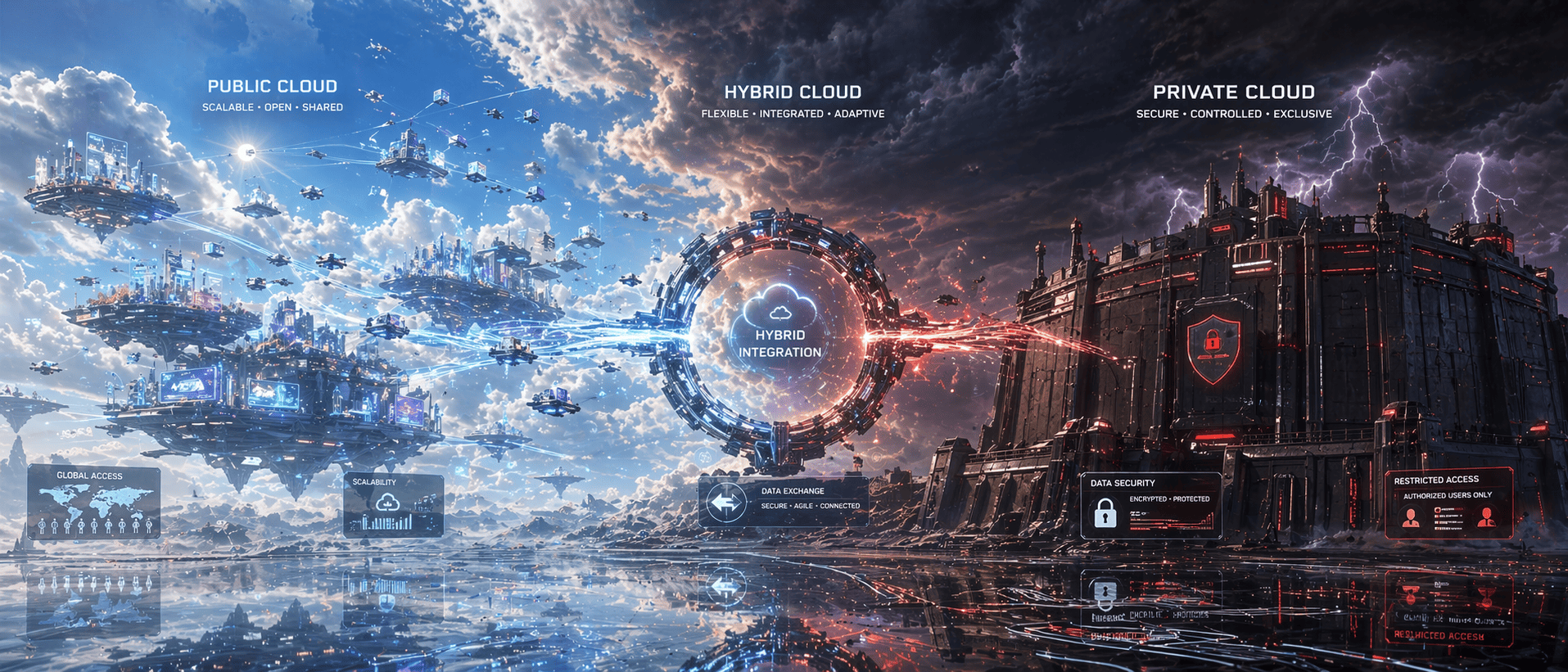
If you’ve ever wondered where your photos, games or school files actually live when you upload them online you’re already thinking about the cloud. No not the fluffy white ones in the sky we’re talking about cloud computing which is basically using the internet to store data and run apps instead of relying only on your personal computer. But here’s where it gets a little confusing there isn’t just one kind of cloud. There are public clouds, private clouds and hybrid clouds. Each one works differently and companies and even schools choose between them depending on what they need.
Let’s break it down in the simplest way possible.

What is Cloud Computing?
Before jumping into types think of cloud computing like renting space instead of owning it. Instead of buying a super expensive computer server, businesses can just “rent” storage and computing power online. It’s like using Google Drive instead of saving everything on a USB.
Public Cloud (The “Shared WiFi” of the Internet)
What is a Public Cloud?
A public cloud is a cloud service that anyone can use. It’s run by big companies and shared between lots of users.
Examples:
- Google Drive
- Dropbox
- Microsoft Azure
How it works:
Imagine a huge apartment building. Everyone rents a room but the building is owned and managed by someone else. That’s basically public cloud.
Pros:
- Cheap (sometimes free)
- Easy to use
- No maintenance needed
- Scalable (you can upgrade anytime)
Cons:
- Less control
- Security can be a concern for sensitive data
- Shared environment
Best For:
- Startups
- Students
- Small businesses
- Apps with lots of users
Private Cloud (Your Own Personal Space)
What is a Private Cloud?
A private cloud is used by only one company or organization. It’s not shared with others.
How it works:
Think of this like owning your own house instead of renting an apartment. You have full control over everything.
Pros:
- High security
- Full control
- Custom setup
Cons:
- Expensive
- Needs maintenance
- Requires IT expertise
Best For:
- Banks
- Government organizations
- Big companies handling sensitive data
Hybrid Cloud (The Best of Both Worlds)
What is a Hybrid Cloud?
A hybrid cloud is a mix of public and private cloud. It allows data and apps to move between both environments.
How it works:
Imagine you have a house (private cloud) but still use a storage unit outside (public cloud) when needed.
Pros:
- Flexible
- Cost-efficient
- Better security control
- Scalable
Cons:
- More complex to manage
- Needs good planning
Best For:
- Growing businesses
- Companies with mixed workloads
- Organizations needing both flexibility and security
Public vs Private vs Hybrid Cloud (Quick Comparison)
Public Cloud:
– Cost: Low
– Security: Moderate
– Control: Low
– Scalability: High
– Maintenance: Provider
Private Cloud:
– Cost: High
– Security: High
– Control: Full
– Scalability: Limited
– Maintenance: You
Hybrid Cloud:
– Cost: Medium
– Security: High
– Control: Partial
– Scalability: Very High
– Maintenance: Both
Which One Should You Choose?
Honestly, it depends on what you need.
- If you’re just storing photos or building a small app → Public Cloud
- If you’re handling sensitive data → Private Cloud
- If you want flexibility and growth → Hybrid Cloud
Most modern companies are actually moving toward hybrid cloud because it gives them the best balance.
Why This Matters (Even for Students)
You might think this is only for big companies but it’s actually super relevant:
- Your favorite apps use cloud computing
- Online games rely on cloud servers
- School tools like Google Classroom use public cloud
So yeah, you’re already using cloud tech every day without even realizing it.
Final Thoughts
Cloud computing isn’t just a trend it’s the future. Whether it’s public, private or hybrid cloud each option has its own strengths. If you understand these basics now you’re already ahead of a lot of people. And who knows? Maybe you’ll end up building the next big cloud powered app someday.